
Survive...or Thrive?
Challenging the "Just Deal With It" Mentality
DISCUSSION
ThePurplePlague
12/3/20252 min read
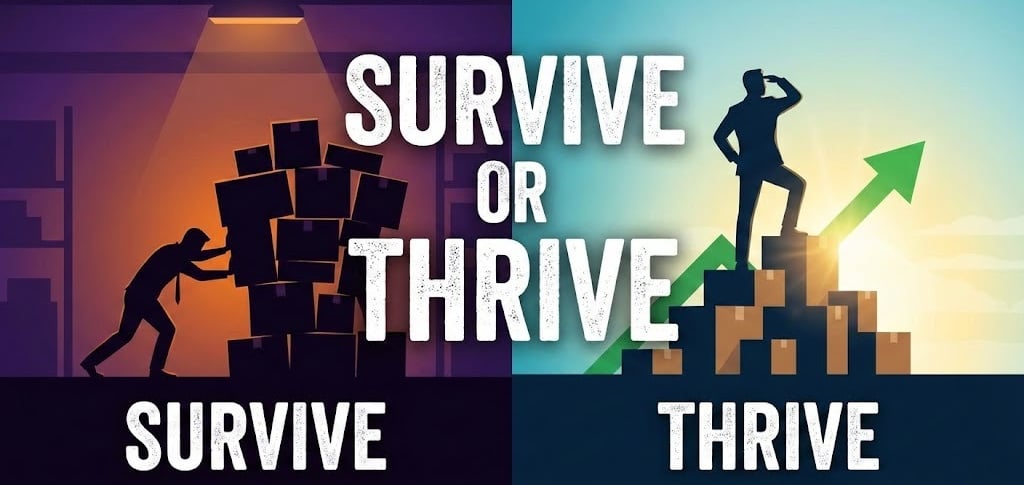

Survive, or Thrive:
Challenging the "Just Deal With It" Mentality
To our dedicated team at the Hagerstown Hub:
We work in a demanding industry. Moving thousands of packages a shift requires grit, physical endurance, and mental toughness. There is a certain pride in being able to handle the volume, clear the rollerlines of IC's, and get the job done when others might quit or burn out.
However, we’ve noticed a recurring sentiment on the floor and even in some of our initial survey responses, a sentiment that has plagued this building for most of its lifetime:
"This is just how it is. It's Peak Season. The pay is good, and if you can't handle the pressure, maybe this job isn't for you."
We need to talk about why this "Just Deal With It" mentality—while born from a place of resilience—is actually dangerous for us all.
The Difference Between Hard Work and Unsafe Work
There is a massive difference between working hard and working unsafe.
Hard Work is sweating through a heavy flow of packages while following proper methods, proving yourself to be able to handle whatever is thrown at you while not putting your body at risk of permanent injury.
Unsafe Work is the mandatory, rapid single-lifting of hundreds of 80+ lb. boxes—a direct consequence of understaffing driven by metrics—that threatens to end your physical ability to work not only this job, but any job ever again.
When we accept unsafe conditions as "just part of the job," we are normalizing negligence. We are telling management that it is acceptable to ignore the "Safety Above All" (POLICY-013) mandate. We are telling them that our bodies are disposable.
Why "Good Pay" Doesn't Justify Systemic Failure
Some argue that the paycheck justifies the chaos. But let's look closer at that transaction.
When management mandates a six-day week—pushing Part-Time handlers past 30 hours and Full-Time handlers past 60—the body is running on fumes. In a typical office or service occupation, this level of overtime is draining; in a physically demanding role like ours, the impact on our muscles, joints, and alertness is exponentially more intensive and dangerous.
When you are forced to rush at 1,000 PPH to cover for broken equipment, you are not being paid extra for that risk. You are absorbing the cost of the company's maintenance failures with your own physical health.
A fair wage is compensation for your time and labor, not a bribe to accept hazardous conditions.
Shifting from Survival to Standards
The goal of The Purple Plague isn't to complain about hard work. It's to ensure that our hard work is supported by the standards the company claims to uphold.
We shouldn't have to "survive" a shift because the rollers are broken.
We shouldn't have to "deal with" blocked fire exits because there's no one to clear the egress.
We shouldn't have to accept a T-shirt in place of fair compensation for mandatory overtime.
Your Resilience Deserves Better
True toughness isn't just enduring a bad situation; it's having the courage to demand a better one.
If you see a hazard, report it. If you feel the pressure to skip safety protocols, address it.
Don't just survive the shift—help us build a hub where we can all thrive safely.
Challenge the narrative. Share your reality in our confidential survey.